
Cluster Pays vs Cascading Reels: How Modern Slot Mechanics Work

Cluster Pays vs Cascading Reels: How Modern Slot Mechanics Work

Slot terminology can get confusing because several mechanics may activate during the same spin. You land a group of matching symbols, they explode, new ones drop down, another group forms, and a multiplier suddenly increases. Which feature actually caused what?

The Cluster Pays vs Cascading Reels distinction clears up much of that confusion. Cluster Pays defines the shape or connection needed to create a winning combination.

Cascading Reels deal with what happens after winning symbols have been identified. Understanding them individually makes modern grid slots, tumble games, and even cascading payline titles much easier to follow.

Cluster Pays Replaces Traditional Line Patterns

Traditional slots usually evaluate symbols along paylines or consecutive reels.

Cluster Pays removes the need for those fixed routes.

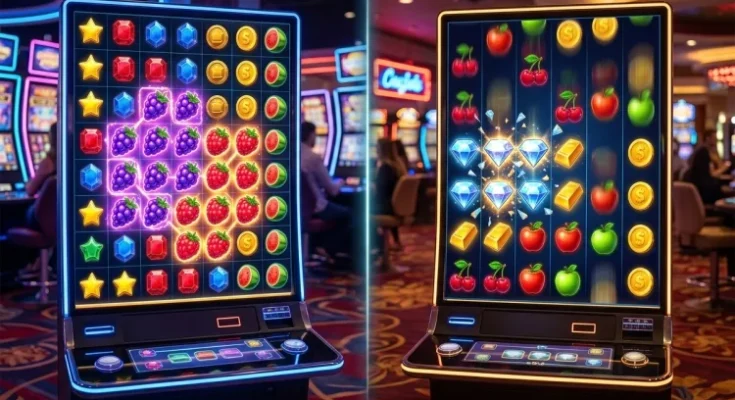
Instead, matching symbols form a win by connecting to each other across a grid.

Funk Master illustrates the concept clearly. Evolution explains that groups of at least five identical symbols connected horizontally or vertically create a Cluster Pays win.

That means a winning group can have a strange shape.

It might resemble an L, T, block, or irregular chain.

The important factor is connection rather than alignment on a predefined line.

This format works especially well on large square grids because there are many directions in which a group can spread.

Cascading Reels Begin After a Win

A cascade normally starts once the game has already decided that a winning combination exists.

The relevant winning symbols disappear.

Symbols above the cleared positions move downward, while replacements enter the screen.

The game then checks the new layout for another result.

If another win occurs, the process repeats.

This is often called a cascade, tumble, reaction, drop, or Avalanche depending on the provider.

Play’n GO’s Blitzways explanation, for example, describes cascading wins as winning symbols disappearing while new symbols drop into place and potentially create consecutive wins.

The idea is easy to understand once you seperate it from the payout system.

Cluster Pays finds the win.

The cascade continues the sequence.

A Single Game Can Use Both Systems

Many modern slots deliberately combine the two mechanics because they complement each other.

Take Hot Pepper.

Pragmatic Play uses a 7×7 grid where at least five matching adjacent symbols create a cluster. Once the cluster pays, its symbols disappear and the tumble system fills the empty positions with replacements.

Sugar Rush works similarly.

Five or more horizontally or vertically connected symbols create a qualifying cluster. Those symbols then explode, triggering tumbles that can produce additional clusters.

This creates an important chain:

cluster forms → payout occurs → symbols disappear → replacements fall → new grid is checked.

If another cluster appears, the sequence continues.

The initial spin does not need to be paid again for every tumble in the chain.

Cascades Also Work With Traditional Paylines

The most useful comparison comes from games where cascading exists without Cluster Pays.

Gonzo’s Quest uses twenty paylines on a five-reel, three-row layout.

When a winning payline combination forms, the symbols involved disappear through the Avalanche feature and fresh symbols fall down.

Nothing about that process requires a cluster.

The winning condition is still based on paylines.

Timber Stacks provides another variation. Matching symbols need to land from left to right rather than forming connected clusters, yet winning combinations are removed through its Tumble mechanic and replaced by new symbols.

These examples make the distinction very clear.

Cascading is a post-win mechanism that can be attached to many different payout systems.

Cluster Pays Does Not Automatically Mean Cascades

Although the combination is common, the concepts remain separate.

A developer could design a cluster game that simply pays the connected group and ends the spin immediately.

Likewise, a cluster system could trigger another unrelated feature instead of replacing symbols.

The reason cascades appear so often is practical.

When part of a large grid is cleared, falling replacement symbols naturally fit the visual design and can create new connections.

That makes Cluster Pays and Cascading Reels feel almost inseparable in many popular games.

But mechanically, one determines qualification, while the other determines continuation.

Thinking about them this way prevents a lot of confussion when reading feature descriptions.

Why Large Grids Work Well With Cluster Pays

Large grids create more potential contact points between matching symbols.

A 7×7 board has forty-nine positions.

This allows groups to form vertically, horizontally, and around other symbols in irregular patterns.

Candy Rush uses a 7×7 grid and awards cluster wins when five to fifteen or more matching sweet symbols connect. It then uses tumbling reels to continue the sequence.

Cosmic Clusters uses a 6×6 layout with clusters of five to fourteen matching symbols. Winning groups trigger tumbles and interact with additional Wild and Money-symbol mechanics.

Grid size can therefore influence how visually complex cluster formation becomes.

Still, a larger grid does not automatically mean higher RTP or more frequent payouts.

The mathematics behind symbol distribution remains critical.

Cascades Can Build Multipliers

One reason cascading games feel different from ordinary spin-and-stop slots is that consecutive wins can sometimes improve feature values.

Gonzo’s Quest increases its win multiplier during consecutive Avalanches, with the multiplier resetting after a non-winning sequence.

Modern cluster games frequently take this concept further.

Sugar Rush 1000 uses multiplier spots that can rise as winning symbols repeatedly explode on the same positions, with values reaching up to 1,024x according to Pragmatic Play’s game description.

Candy Rush uses multiplier underlays that can double during winning tumbles, up to its stated limit.

These multipliers make longer tumble sequences potentially more significant.

But multipliers are an additional layer.

A cascading mechanic does not automatically need one.

Cluster Size Affects Payouts

In many cluster games, larger groups pay more.

Suppose five matching symbols create a basic win.

A cluster containing eight, ten, or fifteen symbols might pay at a higher multiplier depending on the paytable.

Cosmic Clusters, for example, pays clusters ranging from five to fourteen matching symbols under its stated rules.

Candy Rush uses groups of five to fifteen-plus symbols, with values increasing according to symbol type and cluster size.

This is conceptually similar to landing more matching symbols on a traditional payline.

The difference is geometric.

Instead of extending a line across more reels, you expand the connected group across the grid.

That makes cluster size one of the first things to check in the paytable.

Cascades Change the Meaning of One Spin

A traditional non-cascading spin usually has a clear endpoint.

The reels stop, wins are evaluated, payouts are added, and the next wager begins.

Cascading games can create several evaluations from the same initial wager.

Imagine the first layout produces one cluster.

It disappears and creates another.

That second cluster triggers a third tumble.

The game keeps checking until no qualifying win remains.

This can make one spin last much longer than another.

However, the presence of multiple cascades does not mean the player has found a predictable pattern.

Each game’s RNG and symbol mechanics still determine the outcomes.

A sequence that produces six tumbles on one spin can be followed by a spin with none.

Past sequences do not guarantee what will happen next.

Which Mechanic Is Easier for Beginners?

Cascading Reels are usually easier to understand first.

You see a win disappear and new symbols fall into the empty positions.

The visual logic is obvious.

Cluster Pays can require slightly more adjustment because players accustomed to paylines naturally search left to right.

A good way to learn is to open a demo of a cluster game and deliberately identify groups before the game highlights them.

Look for five connected symbols.

Then watch which ones disappear when the tumble begins.

After a few rounds, the connection between the two mechanics becomes much clearer.

The practical goal is not deciding which is “better.”

It is understanding which part of the result each mechanic controls.

Does One Produce Higher RTP or Lower Volatility?

Neither mechanic guarantees a particular mathematical profile.

A cluster game can be low, medium, or high volatility depending on its design.

The same is true for cascading slots.

Developers can change symbol weighting, payouts, bonus frequency, multiplier behaviour, and maximum-win limits while keeping the same basic mechanic.

That means Cluster Pays vs Cascading Reels should not be treated as an RTP comparison.

Instead, check the specific game’s published RTP and volatility information separately.

Also inspect whether most value comes from ordinary grid wins, long tumble sequences, Free Spins, or multipliers.

Two games using the same feature names can still behave very diferently.

The Cluster Pays vs Cascading Reels comparison is easiest when you separate win formation from win continuation.

Cluster Pays rewards groups of connected matching symbols, while Cascading Reels remove winning symbols and refill the board for potential follow-up results.

Many slots combine both, but cascades can also work with paylines or ways-to-win systems. Read each game’s paytable and feature rules before comparing them.

iPhone Slots Guide: Safari vs Apps for Mobile Play

iPhone Slots Guide: Safari vs Apps for Mobile Play

The iPhone has changed mobile gaming by making browser experiences much closer to installed apps.

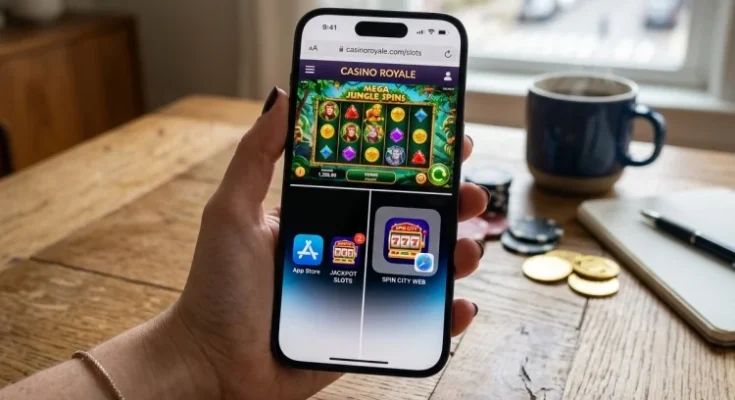
For slot players, that means downloading casino software is no longer the only practical option. Safari can run compatible games directly, while web apps can even place a website icon on the Home Screen.

This iPhone Slots Guide compares those choices from a technical and practical perspective.

Instead of asking which format is universally better, it looks at compatibility, installation, storage, security, updates, permissions, and regional availability so you can understand what each option actually offers.

Safari Is Usually the Lowest-Commitment Option

Safari play requires very little setup.

Open the casino website, sign in, choose a slot, and launch the game.

There is no separate casino application to install, which makes browser gaming convenient for someone who only uses a platform occasionally.

Safari can also retain bookmarks, website data, and login information depending on your privacy settings.

Modern responsive websites adapt their layout to different iPhone screen sizes, allowing reels and controls to remain usable in portrait or landscape configurations where supported.

You should still expect an internet connection to be required.

The fact that a slot loads inside Safari does not mean it runs completely on your phone. Game servers normally remain part of the process, particularly for real-money gaming.

App Store Apps Offer a More Dedicated Environment

A native iOS application can create a cleaner experience.

Instead of navigating through browser tabs, the operator can organize games, account settings, promotions, deposits, withdrawals, and support inside one application.

Apps can also integrate with iPhone features such as Face ID or system notifications when implemented.

However, Apple’s App Store rules make real-money gambling applications a special category.

Apple requires casino and other real-money gaming apps to have the necessary licensing and permissions for every location where they operate, to be geographically restricted to those locations, and to be distributed free of charge.

This means app availablity can change according to region.

If you cannot find a particular casino application in your App Store, that does not necessarily mean your iPhone is incompatible.

The service may simply not distribute an app in your jurisdiction.

Web Apps Blur the Line Between Safari and Native Apps

Safari offers another format that many users overlook.

A compatible website can be added to the Home Screen and configured to open as a web app.

Apple’s current iPhone guidance says users can open a site in Safari, choose Add to Home Screen, switch on Open as Web App, and create an icon that launches the website with an app-like experience.

Web apps can also receive notifications where supported.

For a casino platform, this can provide the convenience of an icon without requiring a conventional App Store download.

It is important to understand what this does not mean.

A Home Screen web app still depends on the underlying website and browser technologies.

It does not automatically gain every capability available to a native application.

Check iOS Before Blaming the Game

Compatibility problems can appear for many reasons.

A game may have been built for newer browser standards. The operator’s app may require a newer iOS release. The phone may also be running low on storage or memory.

Keeping iOS updated is one of the simplest maintenance steps.

Apple states that software updates deliver features, security updates, and bug fixes, and provides automatic download and installation controls through Settings > General > Software Update.

When a slot suddenly refuses to load, try a basic checklist before assuming the game is incompatible.

Reload Safari, close unnecessary tabs, confirm your network connection, restart the iPhone, and check for software updates.

If only one game fails while everything else works, the problem may be with that specific title or provider rather than your phone.

Older iPhones Can Still Work, but Performance Varies

Slot games differ significantly in graphical demands.

A simple three-reel classic may require relatively little processing, while a six-reel video slot with cascades, animated 3D characters, sound effects, and several moving overlays can place greater demand on the browser.

Older iPhones may therefore handle different games differently.

Storage matters as well.

Apple recommends checking Settings > General > iPhone Storage when space is limited. Users can review how much space individual apps consume and remove or offload unused apps.

Apple also notes that maintaining available storage can help avoid performance problems.

A nearly full device might perform poorly even when a game is technically compatible.

That is why compatibilty should be viewed as more than a yes-or-no label.

Safari Can Be More Storage-Friendly

An installed casino app takes dedicated storage.

Depending on its design, additional cached graphics and resources may increase that footprint over time.

Safari browser play generally avoids maintaining a full operator application, although websites can still use cache, cookies, downloads, and local data.

If you have a high-capacity iPhone, the difference may be irrelevant.

For a device with limited free space, browser access can be more attractive.

This is also useful if you occasionally visit several different platforms.

Installing five casino apps simply to access one or two games from each service may make little sense when responsive browser versions exist.

Remember that Safari itself and website data still consume resources, so browser play is lighter rather than completely storage-free.

Safari Security Starts With the Correct Website

One of the biggest risks with browser play is arriving at the wrong website.

Phishing sites can imitate real operators, sometimes changing only a character or two in the domain.

Safari includes a Fraudulent Website Warning for suspected phishing pages.

Apple also lets users inspect connection security details and warns against entering private or financial information on websites that do not use secure encrypted connections.

HTTPS is important, but it is not enough by itself.

Apple specifically notes that encryption does not guarantee that a website is trustworthy, because fraudulent sites can also use encryption.

Check the exact domain before signing in.

Once you have verified the official site, saving it as a bookmark or Home Screen web app can reduce the need to search for it repeatedly.

Apps Avoid Fake Websites but Still Need Verification

App Store distribution can reduce some browser-related risks, but users should still verify the developer.

Look at the app name, developer identity, region availability, and whether the operator’s official website links to that App Store listing.

Real-money gambling applications are subject to Apple’s licensing and geo-restriction requirements, but that does not mean every gaming-looking app is a real-money casino.

Some apps may be social casino games using virtual currency, information services, or unrelated products with similar names.

Do not assume that two applications belong to the same company simply because their icons look similar.

The safest route is to navigate from the verified operator website to its official App Store entry when possible.

Location Access Can Affect Real-Money Compatibility

Real-money gambling is heavily dependent on jurisdiction.

An operator permitted to offer casino games in one location may have to block them elsewhere.

That is why location permission can become part of the mobile experience.

Apple allows users to control location access for individual apps through Location Services, including options such as allowing access while using the app or refusing permission.

Safari has similar website controls.

Users can configure location, camera, and microphone access globally or create exceptions for particular websites.

A legitimate casino may need location information to verify geographic eligibility.

However, permissions should still make sense.

If a simple slot website unexpectedly asks for microphone or camera access without explaining why, review the request rather than approving it immediatly.

Safari Privacy Features Can Affect Some Services

Safari includes several privacy protections.

Apple’s current settings include Prevent Cross-Site Tracking, Hide IP Address options, Fraudulent Website Warning, and website-specific permission controls.

These tools generally improve privacy, but certain services that rely on geographic or network checks may occasionally require specific information.

For example, Apple notes that a website relying on IP filtering may require an IP address to be visible, and Safari provides a temporary Show IP Address control for such cases.

That does not mean you should routinely disable privacy protections.

If a verified platform has trouble determining your location, follow its official troubleshooting instructions rather than changing multiple Safari security settings at random.

App Updates and Safari Updates Work Differently

Native apps need application updates.

Apple says App Store apps update automatically by default, although users can turn this setting off and update applications manually.

Safari-based platforms are different.

Much of the casino interface can be updated by the operator on its servers, meaning you receive changes when the website reloads.

Safari itself is part of the iOS environment, so keeping iOS updated remains important.

This difference makes browser platforms easier to maintain in some situations.

There is no need to download a seperate casino application update every time the operator changes a menu or game catalogue.

Still, both formats depend on current software for security and compatibility.

Safari or App: Which One Fits Better?

Safari makes sense when you want fast access, minimal installation, and lower dedicated storage use.

It is also practical when an operator offers legal browser service in your location but does not provide an iPhone app.

A native application can be attractive if you frequently use the same operator and prefer one dedicated interface.

A web app offers an interesting compromise.

It gives you a Home Screen icon while keeping the underlying platform web based.

Whichever route you choose, evaluate the service itself first.

Licence status, regional eligibility, security, and trustworthy account handling matter far more than whether the reels appear inside Safari or an App Store application.

This iPhone Slots Guide shows that Safari, native casino apps, and Home Screen web apps each have practical advantages. Safari is flexible and storage-friendly, while apps provide dedicated access and deeper iOS integration.

Check device compatibility, software updates, permissions, location requirements, and security before choosing. Use only verified services and select the format that runs reliably on your iPhone.

Best Types of Free Slots: A Beginner's Learning Path

Best Types of Free Slots: A Beginner’s Learning Path

Free slots are most useful when you treat them as practice rather than simply spinning until the virtual balance disappears.

Different slot formats can teach different skills, from reading a paytable to understanding Wild symbols, volatility, cascades, and changing ways to win.

The Best Types of Free Slots for beginners therefore depend on what you are trying to learn.

A three-reel classic is great for basic payouts, while a modern Megaways game is better for understanding variable reels. Following a simple learning order prevents advanced features from becoming overwhelming.

Level One: Classic Slots for Understanding Reels

Your first goal should be understanding what reels and symbols actually do.

Traditional three-reel slots are ideal because very little happens on the screen that needs explanation.

Yggdrasil’s Extreme Hot Gems is a modern example of this old-school structure. The game has three reels, three rows, five winning lines, and left-to-right payouts. Yggdrasil also lists its volatility as Low.

That simplicity lets you concentrate on symbol values.

Open the paytable and compare a three-symbol combination with a two-symbol result where applicable. Notice how different symbols can carry very different payout multipliers.

Also watch how the bet affects the displayed win.

Learning this relationship first gives you a foundation for every more complicated slot format.

Level Two: Fixed Paylines for Learning Winning Patterns

The next step is a five-reel game with clearly defined paylines.

Paylines teach you that matching symbols often need to appear in specific positions.

Yggdrasil’s Hell’s Hogs provides a straightforward example with five reels, three rows, and 20 paylines. The game also includes several bonus features, making it useful for moving beyond pure classic gameplay.

During free play, do not only look at the final win amount.

Try to identify the actual line that created it.

If a symbol appears on reels one, two, and three, check whether the positions line up with one of the active winning patterns.

This exercise quickly teaches why three identical symbols may sometimes pay while another apparently similar arrangement does not.

After a few hundred practise spins, payline logic should become almost automatic.

Level Three: Simple Wilds and Scatters

Next, find a slot with basic Wild and Scatter symbols.

Wilds are useful because they teach substitution. A Wild may replace normal paying symbols to complete a combination, although the game’s paytable should always tell you which symbols it can replace.

Scatters introduce another concept.

Unlike ordinary line symbols, they may trigger Free Spins or other features according to their own placement rules.

Use free mode to deliberately inspect every new symbol you encounter.

Do not assume a golden icon is automatically a Wild or that three special-looking symbols always trigger a bonus.

One slot may require three Scatters. Another might reward additional spins for four or five.

Reading those differences is one of the most usefull habits a beginner can build.

Level Four: Free Spins and Retriggers

Once Wilds and Scatters are familiar, concentrate on Free Spins.

Start with a bonus where the rules are easy to follow.

For example, three Scatters might award a set number of free rounds. Additional Scatters during the feature may then provide a retrigger.

This teaches you the difference between base-game rules and bonus-game rules.

Some symbols can gain extra powers inside Free Spins. Multipliers may also appear only during the feature.

Use the free version to check these changes without focusing on the virtual money.

Ask yourself what activated the feature, what changed when it began, and what would extend it.

This method is much more educational than simply pressing autoplay and watching the balance move.

Level Five: Low-Volatility Games for Understanding Risk

After learning features, explore volatility.

A low-volatility free slot can provide a useful introduction because the payout distribution is generally designed to be less extreme than that of a high-volatility game.

Yggdrasil’s current catalogue includes games explicitly classified by volatility. For example, 3 Piggies of Bank is listed as Low volatility with a published hit frequency of 25.2%, although available RTP configurations vary.

Try comparing a low-volatility game with one officially labelled high or super high.

Do not judge them from 20 spins.

Instead, look at balance movement, size of ordinary wins, longest quiet periods, and how heavily results depend on bonuses.

A demo cannot tell you what the next spin will do, but it can help you understand why two games with similar-looking RTP percentages may feel very diffrent.

Level Six: Ways-to-Win Games

Once fixed paylines make sense, remove them from the equation.

Ways-to-win games calculate combinations differently. Instead of using predefined line shapes, matching symbols generally need to appear across qualifying consecutive reels.

The position of a symbol within each reel may therefore matter less than it does on a fixed payline.

This is a useful learning stage because it prepares you for Megaways.

Watch what happens when one matching symbol appears on the first reel, two appear on the second, and three appear on the third.

Depending on the game’s rules, those repeated symbols can create multiple combinations.

That explains why a payout can sometimes be larger than you expected from simply looking at one sequence across the screen.

Always check the game’s specific rules because not every ways system is identical.

Level Seven: Megaways for Variable Reel Structures

Megaways takes ways-to-win mechanics another step further.

In many Megaways titles, each reel can display a changing number of symbols, which changes the available winning ways from one spin to another.

Big Time Gaming’s Fireworks Megaways uses up to 117,649 ways to win and combines the format with cascading reactions.

This is exactly why it belongs later in a beginner’s learning path.

You are simultaneously dealing with changing reel heights, variable winning ways, cascades, Wild features, and Free Spins.

Play slowly.

Look at the ways counter before the spin and again after the reels settle. Then inspect how a cascade removes winning symbols and allows replacements to enter.

Once traditional ways games are familiar, this changing structure is much less confussing.

Level Eight: Cluster Slots for a Completely Different Logic

Cluster games are useful after you understand conventional reels because they demonstrate that slots do not need paylines at all.

Evolution’s Funk Master uses a Cluster Pays structure. At least five adjacent matching symbols can form a cluster, and winning symbols disappear before the Avalanche mechanic fills the empty spaces.

Instead of reading the screen from left to right, you look for connected groups.

This changes the way you visually interpret a result.

During free play, compare a cluster game’s paytable with a traditional five-reel slot.

Notice how many assumptions no longer apply.

That comparison is valuable because it teaches you to read the rules of each game rather than assuming every slot operates the same way.

Why Legitimate Free Play Is Useful for Learning

A common concern is whether demo slots are deliberately easier than real-money versions.

Regulated environments have rules addressing this issue.

The UK Gambling Commission states that play-for-free games offered alongside corresponding real-money versions on the same facility must implement the same game rules.

Operators must also take reasonable steps to make sure winning likelihood and prize distribution are accurately represented.

That makes legitimate free mode useful for understanding mechanics.

It does not mean your specific demo results will repeat later.

Random outcomes can produce completely different sequences from one session to another.

Use free play to study rules, interfaces, payouts, and features – not to search for a winning pattern.

What Beginners Should Avoid at First

Feature-heavy slots are not necessarily bad, but they can be poor teaching tools for someone starting from zero.

A game may combine Megaways, cascades, progressive multipliers, expanding Wilds, mystery symbols, jackpot wheels, and Bonus Buy options.

If five systems activate simultaneously, you may see a payout without understanding how it was calculated.

Start simple and add one major concept at a time.

Classic reels teach symbols. Paylines teach positioning. Wilds teach substitution. Scatters teach triggers. Free Spins teach bonus rules. Ways teach combination multiplication. Megaways teaches variable reels. Clusters teach grid-based wins.

That progression creates a much stronger understanding than randomly trying the most visually complex games first.

The Best Types of Free Slots depend on what you want to learn. Begin with three-reel classics and fixed paylines, then explore Wilds, Scatters, Free Spins, volatility, ways-to-win systems, Megaways, and finally Cluster Pays.

Use each free game as a practical lesson, keep the paytable open, and focus on understanding the mechanic rather than predicting future wins.

What Happens After a Progressive Jackpot Is Won? Behind the Reset

What Happens After a Progressive Jackpot Is Won? Behind the Reset

A progressive jackpot reaching its winning moment looks simple from the player’s side: the prize triggers, somebody celebrates, and the giant number suddenly becomes much smaller. Behind that change is an entire automated process.

Understanding What Happens After a Progressive Jackpot Is Won? reveals how progressive networks remain operational after major payouts.

The winning amount has to be recorded, the correct player identified, the jackpot reset, connected games updated, and the next prize pool activated.

In some systems, reserve funds and new contributions immediately begin preparing the next jackpot.

Step One: The System Freezes the Winning Jackpot Value

When the winning condition is recognised, the progressive system needs to determine the actual amount owed.

This matters because a jackpot meter may still be changing while bets are arriving from multiple connected games.

GLI’s progressive jackpot standards require systems to maintain records including the jackpot hit amount, payout amount, time of the trigger, and identifying information for the winning game or equipment.

That record provides a reference for later reconciliation.

In a large network, the displayed value a player sees can also be slightly behind what the central controller has processed.

Standards therefore include procedures for reconciling network information around the exact moment a jackpot is triggered.

Step Two: The Winner Is Notified

Next comes the part the player actually sees.

The game announces that the jackpot has been won.

GLI-12 states that a winning player should be notified of the jackpot and payout by the end of the relevant game when the jackpot operates internally, or within the specified period when an external jackpot controller is responsible.

The system may also tell other participating players that the jackpot has dropped.

This is especially important for shared progressive networks.

The UK Gambling Commission requires adequate notification of the jackpot’s reset value to participating customers after a winning event.

So when a huge meter suddenly drops while you are playing, it may simply mean another eligible player somewhere on the network has triggered it.

Step Three: The Prize Is Paid or Sent for Verification

Not every jackpot is settled in exactly the same way.

In an online game, some payouts can be credited to the player’s gaming balance through an automated wallet transaction.

Pragmatic Play, for example, describes its Jackpot Play cash prizes as being transferred through the player’s wallet or balance system.

Larger awards can involve additional checks.

According to GLI-12, if a jackpot cannot automatically be credited because of applicable limits or payment requirements, gameplay may stop and authorised personnel must intervene to resolve the payout.

The player may therefore need to complete account, identity, or regulatory checks depending on the operator and jurisdiction.

This is why “won” does not always mean the money will appear in full within a few seconds.

Step Four: The Meter Returns to the Reset Value

Once the jackpot has been triggered, the visible meter does not normally stay at the winning amount.

It resets.

Importantly, it usually resets to a predetermined seed value, not zero.

GLI defines a reset value as the jackpot payoff initially offered before the progressive value starts increasing again. It also specifies that a jackpot should update to this reset amount following an award and then continue normal operation.

Consider a network jackpot with a $1 million seed.

Players push it to $3.8 million before somebody triggers the prize.

Shortly afterward, the meter may return to around $1 million.

The next jackpot is already active even though the previous winner may still be completing payment verification.

Step Five: Reserve Money May Support the New Jackpot

How can the system immediately offer another $1 million jackpot after paying $3.8 million?

One possible answer is advance funding.

Progressive jackpot designs can include a separate reserve, hidden increment, overflow, or diversion pool.

GLI-12 recognises diversion pools that collect a portion of contributions separately from the displayed progressive amount. Depending on the system design, that money may support the next reset value or other jackpot obligations.

Think of it as maintaining two buckets.

One is the jackpot players see.

Another may quietly accumulate money for future system requirements.

However, not every progressive uses exactly this structure, so the specific jackpot documentation should be checked before assuming how a particular seed is financed.

Step Six: Every Connected Game Gets the New Value

A standalone progressive has a relatively simple reset.

A wide-area or multi-site jackpot is more complicated because many participating games need to agree on the new amount.

GLI-12 says that once a multi-site jackpot trigger is acknowledged, the central controller communicates the win and reset information through the connected network.

This communication is essential.

Without synchronization, one game could theoretically show the previous jackpot while another has already started the new cycle.

Older GLI standards also describe progressive controllers automatically resetting to the defined reset amount and continuing normal play while displaying current values throughout the link.

Most of this happens in the background.

From the player’s perspective, the display simply changes.

Step Seven: New Player Contributions Begin Again

After reseeding, the jackpot begins growing from its new starting point.

Progressive games generally increase their prize pools according to predetermined contribution rules.

Pragmatic Play states that its Power Jackpot has separate pots for each jackpot tier and that each tier is reseeded after it is won. Fixed portions of qualifying bets then continue feeding those progressive pots.

For example, imagine the Mega tier resets to $250,000.

As eligible wagers continue, it might grow to $250,500, $270,000, and eventually $500,000 or more.

This process continues until the next qualifying trigger.

The cycle can therefore repeat indefinately:

seed → contributions → growing jackpot → win → reset → new contributions.

What Happens to Contributions During the Reset?

This is a more technical part of progressive jackpot operations.

Players across a large network do not necessarily stop betting while the central system processes the winning trigger.

Some wagers may arrive just before or just after the jackpot message.

Modern GLI standards account for this timing issue. Depending on when a contribution is registered relative to the jackpot message, it can be allocated to the completed jackpot or the next jackpot cycle.

The important point is that legitimate contributions should be accounted for rather than lost in the reset.

This process is especially relevent for jackpots involving many games and locations.

Can Another Player Win Immediately After the Reset?

Potentially, yes, depending on the game’s rules.

There is no universal cooling-off period that means the next jackpot must wait days or weeks.

After the jackpot resets and normal operation resumes, another eligible result could theoretically trigger it according to the game’s mathematics.

For mystery-triggered progressive systems, GLI standards state that a hidden trigger threshold can be newly selected after each jackpot reset.

The size of the recently won jackpot does not dictate how long the next cycle must last.

Likewise, the fact that the meter is close to its seed does not automatically mean the next jackpot is impossible.

Players should rely on the published trigger rules rather than theories about jackpots being “hot” or “due.”

Does Every Jackpot Tier Reset When One Is Won?

Not necessarily.

Multi-tier systems can maintain several independent progressive pots.

Pragmatic Play’s Power Jackpot, for example, operates separate Mini, Minor, Major, and Power tiers. Its description states that each associated pot is reseeded when that particular tier is won.

This means winning one tier does not automatically imply that every other visible jackpot must drop to its seed amount.

Suppose the Major jackpot is won.

The Major meter may reset while Mini, Minor, and Power continue operating according to their own state and rules.

This is why the movement of jackpot meters after a win can vary from one game to another.

What If the System Fails During the Process?

Progressive jackpot systems also need recovery procedures.

A network failure should not simply erase the previous jackpot state.

The UK Gambling Commission’s guidance on interrupted gambling states that progressive jackpot values should be restorable to their state before a system failure when appropriate.

GLI standards likewise require controllers to maintain and recover relevant jackpot information after interruptions.

This helps preserve both the winning player’s claim and the integrity of the next progressive cycle.

The technical details are largely invisible, but they are an important part of making shared jackpot systems work fairly.

What Happens After a Progressive Jackpot Is Won? The system confirms the winning amount, processes the winner, resets the meter to its seed, synchronizes participating games, and begins funding the next prize.

Reserve pools may also support future resets. Before playing a progressive game, read its official rules to understand its jackpot tiers, seed amounts, payout process, and eligibility requirements.

What Is Megaclusters and How Is It Different from Megaways?

What Is Megaclusters and How Is It Different from Megaways?

Megaclusters and Megaways sound as though they belong to the same slot system. That assumption makes sense because both mechanics were created by Big Time Gaming, but they actually produce very different styles of gameplay.

If you are wondering What Is Megaclusters, think of a changing grid rather than changing reels. Megaclusters uses connected symbol groups, splitting mechanics, and repeated reactions.

Megaways, meanwhile, generally changes the number of symbols appearing on each reel, creating a different number of potential winning combinations from one spin to another.

Megaclusters Starts With a Grid

The basic structure immediately separates Megaclusters from many Megaways titles.

Star Clusters, the first game Big Time Gaming released using the format, introduced Megaclusters as an extension of cluster and reaction-style games.

Instead of six familiar vertical reels, the player begins with a compact grid.

Winning combinations are based on groups of matching symbols touching one another rather than standard left-to-right reel patterns.

For example, Star Clusters 2 uses a 4×4 starting board and requires at least five adjacent matching symbols for a cluster win. During Free Spins, the layout expands to 8×8.

This makes the gameplay feel closer to a puzzle-like grid system than a traditional reel machine.

Megaways Changes the Number of Symbols Per Reel

Megaways follows a different principle.

Many classic Megaways slots use six main reels with a variable number of visible positions. The number of symbols on each reel determines the total number of available ways to win.

Bonanza can reach 117,649 ways to win, and Big Time Gaming describes Megaways as a mechanic where the reel configuration can change between spins.

Imagine six reels displaying 3, 4, 5, 4, 6, and 5 symbols.

The number of possible ways would be calculated from those reel heights rather than from fixed paylines.

The important difference is that Megaways changes how many symbol positions exist across the reels before combinations are evaluated.

Megaclusters Changes Symbols After a Win

Megaclusters becomes distinctive after a winning cluster occurs.

In Star Clusters, symbols involved in winning groups can divide into four smaller symbols. These smaller symbols occupy the original symbol area, effectively increasing the number of individual pieces available for the next reaction.

The remaining symbols then collapse, fresh symbols can enter, and another cluster may form.

If another win appears, the reaction continues.

That is very different from Megaways, where reel heights may change but individual winning symbols do not become four smaller icons simply because they formed a win.

This splitting process is the core concept to remember when explaining Megaclusters to a beginer.

Both Mechanics Can Use Cascading Wins

The comparison becomes slightly more complicated because both formats can include cascading or reaction mechanics.

Bonanza combines Megaways with a cascading reel system. Winning symbols disappear and replacements enter, allowing another combination to form during the same sequence.

Therefore, cascades alone do not define Megaclusters.

The key Megaclusters difference is what happens to the winning symbol space.

Rather than only clearing positions, winning symbols can divide and create smaller units that participate in later reactions.

This is why two games may both appear to “cascade,” yet the mathematical and visual structures underneath them can be very diferent.

Cluster Pays and Ways to Win Are Not the Same

The method of forming a win is another major distinction.

Megaways commonly uses ways-to-win mechanics. In many versions, matching symbols must appear across consecutive reels starting from the left.

The symbols usually do not need to follow a fixed payline, but they still depend on reel progression.

Megaclusters uses cluster pays.

Diamond Fruits, another BTG Megaclusters title, uses a 5×5 grid where positions may hold large symbols, blank spaces, or groups of smaller symbols. Five or more matching symbols connecting in a cluster can produce a payout according to the game rules.

So a Megaclusters win may form in a compact area of the grid without following a traditional reel path.

That changes both how results are calculated and how players visually read the screen.

The Number 117,649 Is Mainly Associated With Megaways

The figure 117,649 became strongly associated with classic Megaways slots because six reels displaying seven positions each create:

7 × 7 × 7 × 7 × 7 × 7 = 117,649.

Bonanza and Max Megaways are examples of BTG titles using this maximum ways structure.

Megaclusters does not depend on the same calculation.

Instead, its scale is often described using grid dimensions and the number of individual symbols that can exist after splitting.

The original Star Clusters, for instance, can create dramatically enlarged symbol fields during its reactions and bonus gameplay.

This is why comparing the two mechanics solely by “number of ways” can be misleading.

They measure winning opportunities differently.

Bonus Features Can Change Both Systems

Neither Megaclusters nor Megaways dictates every feature inside a slot.

Developers can combine these core systems with Wilds, multipliers, Free Spins, Scatters, Bonus Buy options, or other mechanics.

Star Clusters 2 adds Gold Wilds with multipliers and an increasing Wild multiplier during its Free Spins.

Megaways titles can also include growing multipliers. Bonanza’s Free Spins feature increases its multiplier after winning reactions, while newer Megaways releases may add completely different modifiers.

Therefore, players should seperate the base mechanic from the extra features.

Megaways explains the variable-reel framework. Megaclusters explains the cluster-and-splitting framework.

Everything else depends on the specific game.

Which Format Is Easier to Understand?

Megaways is often easier for players already familiar with reel slots because the basic layout still resembles a traditional machine.

The biggest adjustment is understanding that reel heights and winning ways change.

Megaclusters can require more attention at first because wins are formed through connected symbols, and the screen may transform as symbols split into smaller pieces.

However, once the cluster rule is understood, the logic becomes straightforward: find the required connected symbols, watch the winning pieces react, then see whether the new grid creates another cluster.

Neither system is inherently better.

They simply offer different ways of structuring slot outcomes.

Megaclusters vs Megaways at a Glance

Megaways primarily changes the number of symbols available on individual reels. That variation creates a changing number of ways to win.

Megaclusters primarily changes the grid through winning reactions.

A useful shorthand is:

Megaways = variable reels and variable winning ways.

Megaclusters = connected clusters, symbol splitting, and expanding reactions.

Both can also use cascades, multipliers, Free Spins, and Wild symbols, which is why the distinction is sometimes less obvious when watching gameplay for the first time.

So, What Is Megaclusters compared with Megaways? Megaclusters is a cluster-based mechanic where winning symbols can divide into smaller pieces and fuel additional reactions.

Megaways instead uses changing reel sizes to create variable winning ways. Check the rules of an individual title before playing, because bonus features, Wild behaviour, grid sizes, and payout requirements can vary significantly.

Horror-Themed Slots: Why Animation Makes Fear Feel Interactive

Horror-Themed Slots: Why Animation Makes Fear Feel Interactive

A creepy background can establish a horror theme, but atmosphere becomes much stronger once the scene starts reacting. A portrait suddenly moves. A vampire transforms. The lights flicker as the reels stop. A shadow passes behind the game board just before a bonus begins.

That sense of movement is one reason Horror-Themed Slots can feel very different from ordinary themed games.

Animation allows the environment to respond to what happens on the reels, while sound gives those movements weight and timing. Horror research in virtual environments shows that carefully designed surroundings can generate meaningful emotional reactions, including fear and negative affect.

Slots are obviously not survival-horror games, but designers can borrow the same audiovisual vocabulary—darkness, uncertain movement, abrupt changes, environmental sound, and anticipation—to turn a static theme into an interactive atmosphere.

Animation Makes the Background Feel Alive

A static haunted house is artwork.

A haunted house where curtains move, candles flicker, doors slowly open, and distant figures appear is an environment.

That difference matters.

Even subtle background motion can stop the interface from feeling like reels placed over a poster.

Designers can create atmospheric movement without distracting from gameplay. Fog might drift slowly behind the grid. Clouds can move across a moon. A chandelier can sway slightly during ordinary spins.

Then the animation can become stronger when the game changes state.

The key is contrast.

Normal motion remains subtle.

Feature motion becomes obvious.

That creates a visual hierarchy where players naturally notice mechanical events.

Research into frightening virtual environments suggests that environmental characteristics contribute to emotional responses, which helps explain why movement, spatial cues, and atmosphere can work together so effectively.

Characters Can Visually Announce Features

A horror character can be more than a high-value symbol.

It can become an animated interface element.

Imagine a vampire standing beside the reels. During normal play, the character barely moves. When a special feature activates, the eyes glow, the character transforms, and bats cross the screen.

The animation tells the user:

this event is different.

Play’n GO’s Count Jokula centres its theme around a transforming vampire and connects that idea directly with its Shapeshifter and respin features.

Likewise, Wild Blood 2 uses multiple vampire characters with individual abilities connected to the game’s bonus structure.

This approach creates stronger mechanic-theme alignment.

Instead of displaying an anonymous text box saying “feature activated,” the game world itself announces the feature.

That tends to feel more natural and visually memorable.

Transformation Is Especially Effective in Horror

Horror is full of transformation.

Humans become vampires.

People turn into werewolves.

Normal rooms become supernatural spaces.

Friendly characters become monsters.

These ideas translate unusually well to slot features.

A regular symbol can transform into a wild.

A normal reel can become corrupted.

A character can shift form before triggering a respin.

Play’n GO’s spooky-game catalogue includes examples involving vampires, werewolves, zombies, spirits, and transforming characters, showing how often horror imagery and transformation mechanics naturally overlap.

This works because the mechanic already resembles the story.

When an ordinary symbol turns into a wild, horror animation can present it as a supernatural change rather than simply replacing one image file with another.

The mathematics has not changed.

The presentation makes the mathematical state change feel meaningful.

That is a small but powerfull difference.

Lighting Can Control Attention

Lighting is one of the easiest ways to make a feature feel important.

The screen does not need to become completely dark.

Instead, designers can temporarily reduce background brightness while leaving important symbols illuminated.

A bonus character may appear in a bright doorway.

A wild could glow against a darker reel.

A multiplier can become the brightest object in the scene.

This technique directs attention without adding more interface elements.

Horror environments often use uncertainty and limited visibility to create tension. Research using virtual threat environments similarly employs environmental design and ambiguous cues to create expectations of danger.

Slots can use a much softer version of the same idea.

Darkening the edges of the screen while highlighting a potential feature keeps focus where it belongs.

The danger is readability.

If the design becomes too dark, users may struggle to distinguish symbols or important information.

Atmosphere should never make basic interaction harder.

Jump-Scare Logic Can Become Feature Pacing

A slot does not need literal jump scares to borrow their pacing structure.

The general formula is useful:

normal state,

anticipation,

sudden event,

release.

Research analysing jump scares describes similar temporal stages, including baseline audiovisual levels, anticipation, the arrival of a stinger, and a return toward baseline.

Imagine two scatters landing.

The background begins moving more slowly.

Music fades.

The remaining reel spins.

Then the third scatter appears with a sudden animation and sharp audio hit.

That is essentially horror pacing applied to feature presentation.

The game builds uncertainty and then resolves it.

Importantly, the technique can work even when the result is not frightening.

The genre simply gives designers permission to use more dramatic contrast.

Overusing the method, however, reduces its effect.

If every small win receives a screen-shaking animation, major features no longer feel major.

Reel Animation Can Become Part of the Story

Traditional reel animation has a straightforward job: symbols move and then stop.

Horror games can turn that basic movement into thematic behaviour.

Reels might appear scratched or distorted during a supernatural feature.

A ghost may pass through them.

A monster could physically destroy symbols before replacements appear.

Blood, fog, smoke, or shadows can visually connect cascades with the horror world.

Play’n GO describes Lordi Reel Monsters as using animated monster characters alongside grid interactions, with individual band members affecting symbols and wilds in different ways.

This is stronger than playing an unrelated character animation beside the reels.

The character’s movement has a direct relationship with the mechanical change on the grid.

As a result, the game feels more interactive even though the underlying outcome remains determined by its normal mathematical system.

Sound Gives Animation Physical Weight

Watch a monster slam into the reels with the sound muted.

Then add a deep impact, metallic vibration, and short musical accent.

The animation suddenly feels heavier.

Audio creates a sense of physical consequence that visual motion alone often cannot achieve.

Environmental audio can also suggest unseen threats, with research noting that sounds such as footsteps can imply activity outside the visible scene.

That technique is particularly useful for horror slots because much of the world sits outside the reel grid.

A sound from somewhere off-screen can make the interface feel larger than what is visible.

Developers can also give recurring features unique audio signatures.

A particular growl means one wild type.

A bell signals the scatter.

A rising tone accompanies multiplier growth.

After enough repetition, players can recognise mechanical events by sound even before the animation finishes.

That improves readability while strengthening atmosphere.

Bonus Rounds Can Shift Into a Different Horror World

A feature transition is an opportunity to change more than the reels.

The entire setting can evolve.

A normal game outside a mansion can move inside during Free Spins.

A quiet graveyard can become filled with ghosts.

A human character can transform into a monster.

The colour palette may shift, animation speed can change, and music can move into a more intense arrangement.

Wild Blood 2, for example, builds its features around a haunted mansion and vampire characters, with different bonus mechanics and character powers creating distinct feature states.

These transitions help separate base play from bonuses.

The user does not need to constantly check a counter to know something has changed.

The whole audiovisual enviroment communicates it.

This is where horror themes can be particularly effective because dramatic transformation already fits the genre.

Horror Atmosphere Needs Restraint

More animation does not always mean more atmosphere.

Constantly moving backgrounds can become distracting.

Repeated jump effects become predictable.

Excessive flashes can make features harder to follow.

The strongest horror usually leaves room for expectation.

Research into recreational horror found that enjoyment and fear can have a nonlinear relationship rather than simply increasing together indefinitely. While a slot is a different medium, the broader insight is useful: maximum intensity at every moment is not necessarily the most engaging presentation.

Designers need quiet phases.

A slowly moving shadow may be enough during ordinary spins.

Save the dramatic transformation for a meaningful mechanical event.

This produces better pacing and gives important animations more impact.

It also prevents the interface from becoming visually exhausting.

Horror-Themed Slots become more convincing when animation makes the game world react to features instead of simply decorating the reels. Character transformations, changing lighting, environmental movement, and audiovisual timing can communicate bonuses while building atmosphere.

The strongest designs use restraint, saving dramatic motion for meaningful events. When animation and mechanics move together, horror becomes part of the interaction rather than just the theme.

Virtual Credit Systems in Free Slot Modes: Architecture and Testing

Virtual Credit Systems in Free Slot Modes: Architecture and Testing

A demo slot can create the impression of a complete casino transaction system. Credits decrease when a spin begins, prizes arrive after a win, bonus rounds add more value, and the balance can rise or fall for an entire session.

Yet none of those credits needs to exist outside the game.

Building Virtual Credit Systems in Free Slot Modes is therefore an exercise in controlled simulation. Developers want the game to reproduce the logic and pacing of its real-money counterpart without connecting fictional balances to cash deposits, withdrawals, or financial liabilities.

That sounds easy until bonus rounds, interrupted sessions, configurable stakes, mobile clients, RTP variants, and random outcomes enter the picture. Regulators also expect corresponding demo games to represent real-money rules and prize probabilities accurately in markets such as Great Britain.

The result is a small accounting system with surprisingly serious requirements.

Demo Wallets and Real Wallets Serve Different Jobs

A real-money wallet needs to know how much withdrawable money belongs to a customer.

A demo wallet only needs to know how many fictional units are currently available for simulated gameplay.

That distinction suggests a sensible architectural boundary.

A real-money transaction might involve authenticated player accounts, payment balances, wager records, settlement records, and financial reporting.

A demo session can usually operate with a far simpler state:

virtual balance

current virtual stake

last virtual prize

active bonus state

session identifier

The exact implementation varies between platforms, but logically separating the two reduces the risk that fictional value is mistaken for cash.

The UK Gambling Commission defines play-for-free as a demonstration where a customer is neither staking nor winning money or money’s worth.

That definition provides a useful design boundary: demo credits should look functional without becoming economically redeemable.

Every Spin Needs an Atomic Credit Cycle

One useful implementation pattern is treating each demo spin as one complete balance operation.

Imagine the user begins with 2,000 credits and selects a 10-credit stake.

The spin cycle becomes:

2,000 − 10 = 1,990

The game engine determines an outcome.

If the outcome pays 35 credits:

1,990 + 35 = 2,025

Only after the result is final should the displayed state settle at 2,025.

This is conceptually similar to transaction handling in many software systems: deduct the simulated cost, process the event, then apply the resulting value.

Even though no money is involved, consistent state management matters.

If a mobile connection drops halfway through the animation, the client should not randomly deduct the fictional stake twice when the session resumes.

The credit system must know whether the game cycle has already been completed.

That is an engineering issue rather than a gambling-specific probability rule, but it directly affects whether the demonstration feels reliable.

The Display Layer Should Not Control the Balance

A useful architecture also separates what the player sees from the authoritative game state.

The animation might show coins flying into a meter for three seconds.

That animation should not itself decide how many credits were won.

Instead, the result logic determines the prize, and the interface simply visualises the approved value.

This separation makes testing easier.

Suppose the engine reports a 250-credit prize while the interface accidentally displays 2,500.

QA can identify the problem as a presentation fault rather than a mathematical one.

The reverse can also happen: the interface may look perfect while the underlying calculation is wrong.

Great Britain’s testing strategy uses approved test houses and requires testing to be sufficient to evaluate compliance with its technical standards.

The lesson for developers is simple: do not treat the balance counter as the source of truth.

It is a display of a state calculated elsewhere.

Free-Play Payouts Need to Represent Real Game Rules

Virtual money does not mean arbitrary money.

In Great Britain, play-for-free versions corresponding to paid games on the same facility must use the same rules and accurately represent winning likelihood and prize distribution. The Commission specifically notes that virtual-cash payouts should match their corresponding play-for-money values.

Malta provides another clear requirement: the RTP percentage used by a demo must match the RTP configured for the real-money game.

This affects virtual-credit implementation directly.

Suppose the paid game awards 20× stake for a specific combination.

A demo showing 40× for the same configuration merely to make the game feel more exciting would distort the reward model if presented as the corresponding free version.

The same applies to bonus prizes and multipliers.

The credits are fictional, but their relationship to the rules needs to remain acurate.

Session State Becomes Complicated During Bonuses

Base-game credit logic is relatively simple.

Bonus mechanics create more moving parts.

Imagine a feature containing eight free spins, three sticky wilds, a 4× accumulated multiplier, and 700 credits of pending bonus wins.

Now the browser closes unexpectedly.

When the session resumes, what should happen?

A robust implementation needs enough state information to reconstruct the feature according to the game’s design rather than restarting it incorrectly or crediting the same virtual win twice.

A possible internal snapshot might track the remaining spins, sticky positions, multiplier level, accumulated virtual prize, and current credit balance.

This is particularly important when a bonus contains multiple intermediate stages.

UK Gambling Commission live-monitoring guidance notes that complex games may need performance measurements separated between base-game and feature activity when those features materially affect overall RTP.

That illustrates how bonus states can be meaningful enough to deserve seperate technical attention.

Reset Logic Needs Clear Rules

Demo balances often need replenishment because a fictional player can eventually spend all available credits.

Developers have several options.

A session could automatically restart at 10,000 credits. A “Reset Balance” control could restore the default. Closing and reopening the demo might create a fresh balance.

There is no single universal model across all free slots.

Whatever approach is chosen, reset behaviour should clear the right states.

A reset that restores credits but accidentally preserves a sticky bonus multiplier could create a logically impossible situation.

Likewise, restoring a balance while a previous game cycle is still pending could result in duplicate payouts.

GLI-11 provides a useful related principle for alternative game modes: credits accumulated during test/diagnostic mode are cleared when that mode is exited, while free-play mode is required to be clearly identified and isolated from normal credit and accounting meters.

The broader software lesson is that mode transitions need deterministic cleanup.

Virtual Credits Should Not Pollute Financial Reporting

Imagine a popular demo receives one million free spins in a day.

If every simulated stake were accidentally included in real turnover reports, financial monitoring would become meaningless.

The system therefore needs to distinguish between virtual activity and monetary activity at the data level.

GLI-11 states that its gaming-device free-play mode should not increment normal credit or accounting meters, though clearly identified free-play-specific meters can be maintained.

That is a useful conceptual model even when modern online architectures differ from physical gaming devices.

A provider may still want analytics such as:

demo spins completed,

average virtual stake selected,

bonus features viewed,

or sessions completed.

Those metrics can help QA and product analysis.

They should not be confused with real deposits, wagers, winnings, or operator revenue.

Keeping those namespaces seperate avoids reporting errors and makes investigation much easier.

RNG Logic and Credit Logic Are Different Layers

Another important distinction is between determining an outcome and recording its value.

The RNG or result-generation layer decides which game state occurs according to the applicable mathematical system.

The virtual-credit layer then applies the award produced by that outcome.

Great Britain’s RTS 6 says a corresponding free game can use the same RNG as the real-money version, another RNG satisfying relevant requirements, or another suitable random source that does not introduce systematic bias. Most importantly, the resulting likelihoods and prize distribution must remain representative.

This means a demo balance should not influence the random outcome.

Losing 90% of the starting virtual credits should not make the next bonus “due.”

Likewise, having one million fictional credits should not reduce the probability of a win.

The balance is an accounting state; the random result is a probability state.

Keeping those responsibilities seperate produces cleaner software and clearer testing.

QA Can Test Virtual Credits Aggressively

Because no real money is at risk, developers can deliberately push demo systems into unusual situations.

They can test a balance of one credit against a ten-credit minimum stake.

They can simulate extremely large wins, trigger maximum bonus multipliers, interrupt sessions at awkward moments, refresh the browser repeatedly, and attempt thousands of credit resets.

These edge cases help expose overflow bugs, duplicate awards, negative balances, rounding errors, and broken feature restoration.

Formal regulatory testing still goes much further. The Gambling Commission’s testing framework covers game and software compliance, while live RTP monitoring uses stored transactional data to identify games that may be overpaying or underpaying compared with the intended model.

Free-credit QA is therefore not a substitute for certification.

It is one practical layer of a broader testing strategy.

That distinction is easy to overlook when the demo itself appears so simple.

Virtual Credit Systems in Free Slot Modes combine simulated accounting with real game logic. Developers need to separate fictional balances from monetary wallets, process each demo spin consistently, preserve bonus states, handle resets safely, and keep virtual activity out of financial reporting.

The best implementation feels like the real game mathematically while remaining unmistakably non-cash and technically isolated from real-money transactions.

Norse Mythology Slots Guide: From Odin to Ragnarök Features

Norse Mythology Slots Guide: From Odin to Ragnarök Features

A game does not become authentically Norse simply because it places a horned helmet beside the reels. In fact, developers frequently mix mythology, popular culture, fantasy artwork, and general Viking imagery to create a dramatic setting.

The best Norse Mythology Slots connect their visual choices with understandable mechanics. A rune may function as a multiplier, Thor can add wilds, Freya may control bonus levels, and Ragnarök can become the final free-spin event.

Other games use the same symbols without giving them any meaningful role. This guide explains what to examine when comparing Norse-themed releases, from cultural references and win systems to mobile readability and feature design.

Separate Norse Mythology from General Viking Imagery

Norse mythology concerns gods, supernatural beings, legendary places, and stories preserved largely through medieval texts and archaeological evidence. Viking imagery focuses more broadly on ships, warriors, shields, weapons, raids, and exploration.

The National Museum of Denmark notes that knowledge of Odin, Thor, and other gods comes from sources including the Eddas and Icelandic sagas. Their names also survive in Scandinavian place names.

A game may combine both categories. That creative mixture is normal, but reviewers should avoid presenting fictional details as historical facts.

Check Whether the Runes Make Sense

Runes were alphabetic symbols used to record sounds. The Viking Age alphabet did not contain a separate character for every sound, so readers relied on context when interpreting inscriptions.

Most surviving runic inscriptions are not magical spell books. Many commemorate people, ownership, or ordinary messages, although literary traditions also connect runes with protection and magic.

Slot games usually use runes as colorful matching symbols. That is acceptable as fantasy design, but it is a simplified interpretation.

Look at How Each God Affects Play

A thoughtful game assigns mechanics that match the character’s presentation. Thor commonly controls lightning or wild additions, while Loki creates transformations and mystery symbols.

The original Viking Runecraft assigns different powers to Odin, Thor, Freya, and Heimdall. Its Apocalypse sequel continues that system with unique wild patterns from each god.

The Faces of Freya takes a more focused approach by building several free-spin levels around different aspects of one goddess.

Compare Traditional Reels with Modern Grids

Not every Norse game uses the same structure. Some look like classic three-reel machines, while others use large grids, clusters, changing reel heights, or Megaways.

Riches of Midgard starts as a compact 3×3 game but expands during free spins. Fury of Odin Megaways uses six reels and up to 117,649 winning ways. Viking Runecraft is built around a 7×7 grid.

Compare the winning system before comparing the artwork. A simple payline game and a cascading grid are designed for very different experiences.

Examine the Bonus Progression

A good bonus should explain what the player is trying to achieve. The goal might involve charging a meter, collecting spirit wilds, upgrading a god, or surviving Ragnarök.

Odin Protector of Realms asks players to charge Odin’s forged staff while defending Asgard through a grid-based format.

Viking Runecraft: Apocalypse uses a Spirit Wild collector to unlock Gifts of the Gods before leading into its broader Ragnarök theme.

Visible progression can make a complicated grid easier to follow, especially when each stage has a clear visual effect.

Test Symbol Clarity on Mobile

Detailed warriors, wolves, ravens, helmets, and rune stones can look impressive on a desktop monitor. On a small phone, similar colors or shapes may become difficult to distinguish.

Use demo mode to test portrait and landscape layouts. Check whether the stake, balance, wild symbols, and feature meters remain readable without repeated zooming.

Viking Runecraft and Odin Protector of Realms both publish desktop and mobile presentations, but actual usability can still vary according to the phone, browser, and screen size.

Do Not Choose Only by Maximum Potential

A dramatic theme or large advertised maximum does not explain how frequently features occur. It also does not reveal the game’s volatility or predict a short session.

Check the RTP, stake range, volatility, maximum win, bonus trigger, and whether optional feature purchases are available. Riches of Midgard, for example, lists a 96.03% RTP, an 80x feature-buy cost, and a 1,200x maximum payout.

Those details describe the individual game, not Norse-themed titles as a category.

Norse Mythology Slots range from compact Viking reel games to large grids filled with gods, runes, mystery symbols, and Ragnarök bonuses.

The strongest titles connect the theme with their mechanics instead of using Norse artwork as decoration.

Compare the exact win system, god powers, bonus progression, RTP, volatility, and mobile interface. Remember that real runes were primarily writing symbols and that games freely adapt historical stories for entertainment.

Open several demos, read their help screens, and select the title whose symbols and features remain easiest to understand. Familiar gods may attract attention, but clear gameplay should guide the final choice.

Classic Fruit Slots: How Retro Games Evolved Online

Classic Fruit Slots: How Retro Games Evolved Online

Fruit machines began with physical reels and limited symbol combinations. Modern online versions can use expanding grids, thousands of winning ways, detailed animation, and several bonus systems while still displaying the same familiar cherries and lemons.

The evolution of Classic Fruit Slots shows how digital technology can update an old format without removing its identity.

Some developers preserve the original fixed-line structure, while others use the fruit theme as a foundation for Megaways mechanics, jackpots, feature purchases, and expanding reel areas.

Looking at that development helps explain why the category continues to attract both retro-game fans and players interested in modern features.

From Bells and Gum to Fruit Machines

Charles Fey’s early mechanical designs helped establish the three-reel slot format and the recognizable bell symbol. Later machines used fruit images connected with gum flavors, helping popularize the term “fruit machine,” particularly in the United Kingdom.

The early machines had physical limitations. Reel size restricted the number of possible symbol combinations, and features were controlled by mechanical parts rather than software.

Digital games removed many of those restrictions.

Early Video Versions Preserved the Basic Formula

The first generations of video fruit games generally kept the familiar reel structure. They replaced mechanical parts with screens but continued to use fixed paylines, sevens, bells, and colorful fruit.

Sizzling Hot deluxe is a clear example of this traditional approach. It has five reels and five fixed lines, with NOVOMATIC presenting it as a classic video game.

This style remains available because some players value a focused experience without lengthy bonus instructions.

Wilds and Multipliers Added More Variety

Digital formats made it easier to add symbols that could change how a combination was calculated. Wild icons could substitute for ordinary fruit, while multipliers could increase qualifying awards.

NetEnt’s Fruit Shop combines classic imagery with wild substitutions and a multiplier. Its official information lists a 5×3 layout, 15 paylines, 96.71% RTP, and an 800x maximum payout.

Play’n GO’s Fire Joker adds a respin when stacked symbols appear on two reels without forming a win. A separate wheel can apply a multiplier of up to ten times after a full-screen combination.

Variable Reels Changed the Number of Winning Ways

Megaways games use changing reel heights, so the number of symbols and potential combinations can vary from one spin to the next.

Fruit Shop Megaways updates NetEnt’s earlier game with six reels and between two and seven symbols on each reel. It can offer up to 117,649 winning ways, a progressive free-spin multiplier, and a maximum payout of 5,200x.

The design still looks like a cheerful fruit game, but the mathematical structure is far more complex than the original version.

Expanding Grids and Bonus Modes Add Depth

Modern releases can change the size of the playing area during a bonus. Instead of using one fixed screen, a game may unlock extra rows or feature modes.

Fruit Shop Grand Re-Opening, released in July 2026, begins with a 5×3 structure and can expand through several bonus-spin modes. Its official page lists a 96.37% RTP, a maximum of 5,000x, and playing areas extending as far as 5×6.

This is an example of a classic theme supporting a much deeper modern feature set.

Jackpots Can Be Added to Familiar Games

Providers can also attach jackpot systems to established fruit-game brands. The base reels remain recognizable, while special symbols or bonus rounds provide access to additional prizes.

NOVOMATIC’s Cash Connection version of Sizzling Hot adds jackpot elements to what the company calls classic fruit-game entertainment. Sizzling Hot Treasure Inferno combines the familiar base game with three bonus modes using a Lock & Spin feature.

This approach gives long-running titles a new format without abandoning their original visual identity.

Mobile Technology Supports the Retro Style

Modern fruit games can run in mobile browsers and apps, automatically fitting their controls to smaller screens. Simple symbols often remain clear even when the reel area is reduced.

The lightweight visual concept can also work well on older devices, although actual performance depends on animation, software optimization, memory, and connection quality.

A demo is the easiest way to test whether the layout remains readable on a particular phone.

How to Compare Old and New Fruit Games

Begin with the reel structure and winning system. Then check RTP, volatility, maximum win, paylines or payways, and the rules for any bonus feature.

A classic five-line game may be easier to understand, while a Megaways or jackpot version may provide more variation. Neither style is universally better.

Avoid choosing only by the size of the advertised maximum. A larger theoretical payout does not explain its probability or predict the outcome of a short session.

Classic Fruit Slots have evolved from mechanical three-reel machines into flexible digital games.

Traditional versions preserve fixed paylines and straightforward combinations, while newer releases introduce wild reels, multipliers, changing reel heights, expanding grids, and jackpots.

The fruit symbols remain popular because they provide a recognizable connection between these very different formats. Before selecting a game, decide whether you prefer focused retro play or a modern interpretation with deeper mechanics.

Open the paytable, compare the published specifications, and test both styles in demo mode. The strongest choice is the version whose rules, screen design, and pace are easiest for you to enjoy.

NetEnt Slots Explained: RTP, Volatility, and Game Styles

NetEnt Slots Explained: RTP, Volatility, and Game Styles

Recognizing a game’s title does not mean you already understand how it works. NetEnt frequently revisits famous characters and themes, but sequels may use different grids, mathematical settings, bonus structures, and maximum payouts.

That is why NetEnt Slots should be checked individually.

The provider name can tell you something about the visual style and design history, but it cannot tell you whether a specific game is simple, highly volatile, jackpot-focused, or packed with feature choices.

A quick review of the RTP, volatility, mechanics, and maximum win provides a much clearer picture.

Start with the Exact Version

Record the complete title before comparing any numbers. Labels such as XXXtreme, Megaways, Galaxy, Gold, or Black usually indicate more than a visual update.

The original Starburst uses a 5×3 layout, ten paylines, and expanding wild respins. Starburst Galaxy moves to an Avalanche format, begins on a 5×5 grid, and can expand to 7×7.

Treating both games as interchangeable would create an inaccurate review.

RTP Is a Long-Term Design Figure

Theoretical RTP represents the percentage a game is designed to return across a very large amount of play. It is not a target that every individual session must reach.

RTP varies across NetEnt’s catalogue. Blood Suckers is listed at 98%, Dead or Alive at 96.82%, Starburst at 96.08%, and Gonzo’s Quest at 95.97%.

A difference between two percentages may matter mathematically over long-term play, but it does not predict which title will produce a better short demo session.

Volatility Describes Prize Distribution

Volatility explains how widely results may vary around a game’s theoretical return. Lower-volatility designs generally emphasize smaller and more regular prizes, while highly volatile games can place more of their potential in larger but rarer outcomes.

This does not mean a high-volatility game follows a fixed pattern. It can produce an early feature, while a lower-risk title can still have a quiet session.

Use the official rating where available rather than estimating volatility from a few dozen spins.

Maximum Win Needs Context

Maximum win is normally shown as a multiple of the stake. It represents the highest payout permitted by the game rules, not the likelihood of reaching that amount.

The original Starburst lists an 800x maximum, Starburst XXXtreme lists 16,800x, and Starburst Galaxy lists 17,288x.

The larger figures reflect different mathematical structures and feature sets. They do not automatically make the newer games more enjoyable or suitable for every player.

Feature Complexity Changes the Experience

Some NetEnt titles revolve around one simple mechanic. Others require players to understand several modifiers, bonus choices, or collection systems.

Jumanji includes random reel modifiers and a board-game bonus. Divine Fortune Black offers two Free Spins modes, cash and jackpot symbols, expanding special symbols, and Fortune Collectors.

Complexity can create variety, but it also increases the importance of a clear paytable. A feature is only useful when its trigger and effect are easy to understand.

Sequels Can Change the Core Game

Gonzo’s Quest II illustrates how far a sequel can move from the original. The first game has five reels, three rows, Avalanche wins, and a 2,200x maximum.

The sequel uses six reels, an expanding grid, up to 262,144 winning ways, colossal symbols, bonus features, and a listed maximum of 15,825x.

The shared character provides continuity, but the playing experience is substantially different.

Choose by Style Rather Than Brand Name

Classic payline games may suit readers who value simple controls and familiar rules. Avalanche and cluster games appeal to those who enjoy connected wins and changing grids.

Jackpot titles offer another style, while modern sequels often emphasize optional features, multipliers, and expanding layouts. There is no universal best format.

The strongest choice is the game whose rules, pace, and visual presentation match your preferences.

Evaluating NetEnt Slots begins with the exact title rather than the provider name alone. Check the displayed RTP, official volatility rating, maximum win, reel structure, and bonus conditions before comparing games.

Remember that RTP is a long-term figure and maximum payout describes potential rather than probability.  A classic title may provide clearer, more focused gameplay, while a modern sequel may offer larger grids and deeper features.

Open the information screen, compare several demos, and decide whether you prefer simplicity, connected Avalanche wins, cluster systems, jackpots, or feature-heavy modern releases.