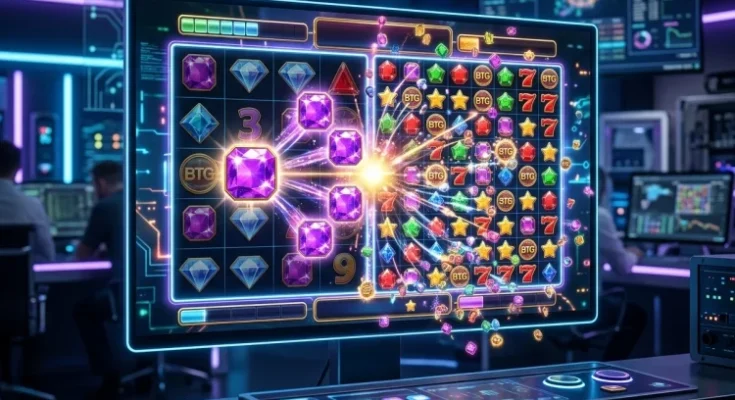

Cluster Pays vs Cascading Reels: How Modern Slot Mechanics Work
Slot terminology can get confusing because several mechanics may activate during the same spin. You land a group of matching symbols, they explode, new ones drop down, another group forms, and a multiplier suddenly increases. Which feature actually caused what?
The Cluster Pays vs Cascading Reels distinction clears up much of that confusion. Cluster Pays defines the shape or connection needed to create a winning combination.
Cascading Reels deal with what happens after winning symbols have been identified. Understanding them individually makes modern grid slots, tumble games, and even cascading payline titles much easier to follow.
Cluster Pays Replaces Traditional Line Patterns
Traditional slots usually evaluate symbols along paylines or consecutive reels.
Cluster Pays removes the need for those fixed routes.
Instead, matching symbols form a win by connecting to each other across a grid.
Funk Master illustrates the concept clearly. Evolution explains that groups of at least five identical symbols connected horizontally or vertically create a Cluster Pays win.
That means a winning group can have a strange shape.
It might resemble an L, T, block, or irregular chain.
The important factor is connection rather than alignment on a predefined line.
This format works especially well on large square grids because there are many directions in which a group can spread.
Cascading Reels Begin After a Win
A cascade normally starts once the game has already decided that a winning combination exists.
The relevant winning symbols disappear.
Symbols above the cleared positions move downward, while replacements enter the screen.
The game then checks the new layout for another result.
If another win occurs, the process repeats.
This is often called a cascade, tumble, reaction, drop, or Avalanche depending on the provider.
Play’n GO’s Blitzways explanation, for example, describes cascading wins as winning symbols disappearing while new symbols drop into place and potentially create consecutive wins.
The idea is easy to understand once you seperate it from the payout system.
Cluster Pays finds the win.
The cascade continues the sequence.
A Single Game Can Use Both Systems
Many modern slots deliberately combine the two mechanics because they complement each other.
Take Hot Pepper.
Pragmatic Play uses a 7×7 grid where at least five matching adjacent symbols create a cluster. Once the cluster pays, its symbols disappear and the tumble system fills the empty positions with replacements.
Sugar Rush works similarly.
Five or more horizontally or vertically connected symbols create a qualifying cluster. Those symbols then explode, triggering tumbles that can produce additional clusters.
This creates an important chain:
cluster forms → payout occurs → symbols disappear → replacements fall → new grid is checked.
If another cluster appears, the sequence continues.
The initial spin does not need to be paid again for every tumble in the chain.
Cascades Also Work With Traditional Paylines
The most useful comparison comes from games where cascading exists without Cluster Pays.
Gonzo’s Quest uses twenty paylines on a five-reel, three-row layout.
When a winning payline combination forms, the symbols involved disappear through the Avalanche feature and fresh symbols fall down.
Nothing about that process requires a cluster.
The winning condition is still based on paylines.
Timber Stacks provides another variation. Matching symbols need to land from left to right rather than forming connected clusters, yet winning combinations are removed through its Tumble mechanic and replaced by new symbols.
These examples make the distinction very clear.
Cascading is a post-win mechanism that can be attached to many different payout systems.
Cluster Pays Does Not Automatically Mean Cascades
Although the combination is common, the concepts remain separate.
A developer could design a cluster game that simply pays the connected group and ends the spin immediately.
Likewise, a cluster system could trigger another unrelated feature instead of replacing symbols.
The reason cascades appear so often is practical.
When part of a large grid is cleared, falling replacement symbols naturally fit the visual design and can create new connections.
That makes Cluster Pays and Cascading Reels feel almost inseparable in many popular games.
But mechanically, one determines qualification, while the other determines continuation.
Thinking about them this way prevents a lot of confussion when reading feature descriptions.
Why Large Grids Work Well With Cluster Pays
Large grids create more potential contact points between matching symbols.
A 7×7 board has forty-nine positions.
This allows groups to form vertically, horizontally, and around other symbols in irregular patterns.
Candy Rush uses a 7×7 grid and awards cluster wins when five to fifteen or more matching sweet symbols connect. It then uses tumbling reels to continue the sequence.
Cosmic Clusters uses a 6×6 layout with clusters of five to fourteen matching symbols. Winning groups trigger tumbles and interact with additional Wild and Money-symbol mechanics.
Grid size can therefore influence how visually complex cluster formation becomes.
Still, a larger grid does not automatically mean higher RTP or more frequent payouts.
The mathematics behind symbol distribution remains critical.
Cascades Can Build Multipliers
One reason cascading games feel different from ordinary spin-and-stop slots is that consecutive wins can sometimes improve feature values.
Gonzo’s Quest increases its win multiplier during consecutive Avalanches, with the multiplier resetting after a non-winning sequence.
Modern cluster games frequently take this concept further.
Sugar Rush 1000 uses multiplier spots that can rise as winning symbols repeatedly explode on the same positions, with values reaching up to 1,024x according to Pragmatic Play’s game description.
Candy Rush uses multiplier underlays that can double during winning tumbles, up to its stated limit.
These multipliers make longer tumble sequences potentially more significant.
But multipliers are an additional layer.
A cascading mechanic does not automatically need one.
Cluster Size Affects Payouts
In many cluster games, larger groups pay more.
Suppose five matching symbols create a basic win.
A cluster containing eight, ten, or fifteen symbols might pay at a higher multiplier depending on the paytable.
Cosmic Clusters, for example, pays clusters ranging from five to fourteen matching symbols under its stated rules.
Candy Rush uses groups of five to fifteen-plus symbols, with values increasing according to symbol type and cluster size.
This is conceptually similar to landing more matching symbols on a traditional payline.
The difference is geometric.
Instead of extending a line across more reels, you expand the connected group across the grid.
That makes cluster size one of the first things to check in the paytable.
Cascades Change the Meaning of One Spin
A traditional non-cascading spin usually has a clear endpoint.
The reels stop, wins are evaluated, payouts are added, and the next wager begins.
Cascading games can create several evaluations from the same initial wager.
Imagine the first layout produces one cluster.
It disappears and creates another.
That second cluster triggers a third tumble.
The game keeps checking until no qualifying win remains.
This can make one spin last much longer than another.
However, the presence of multiple cascades does not mean the player has found a predictable pattern.
Each game’s RNG and symbol mechanics still determine the outcomes.
A sequence that produces six tumbles on one spin can be followed by a spin with none.
Past sequences do not guarantee what will happen next.
Which Mechanic Is Easier for Beginners?
Cascading Reels are usually easier to understand first.
You see a win disappear and new symbols fall into the empty positions.
The visual logic is obvious.
Cluster Pays can require slightly more adjustment because players accustomed to paylines naturally search left to right.
A good way to learn is to open a demo of a cluster game and deliberately identify groups before the game highlights them.
Look for five connected symbols.
Then watch which ones disappear when the tumble begins.
After a few rounds, the connection between the two mechanics becomes much clearer.
The practical goal is not deciding which is “better.”
It is understanding which part of the result each mechanic controls.
Does One Produce Higher RTP or Lower Volatility?
Neither mechanic guarantees a particular mathematical profile.
A cluster game can be low, medium, or high volatility depending on its design.
The same is true for cascading slots.
Developers can change symbol weighting, payouts, bonus frequency, multiplier behaviour, and maximum-win limits while keeping the same basic mechanic.
That means Cluster Pays vs Cascading Reels should not be treated as an RTP comparison.
Instead, check the specific game’s published RTP and volatility information separately.
Also inspect whether most value comes from ordinary grid wins, long tumble sequences, Free Spins, or multipliers.
Two games using the same feature names can still behave very diferently.
The Cluster Pays vs Cascading Reels comparison is easiest when you separate win formation from win continuation.
Cluster Pays rewards groups of connected matching symbols, while Cascading Reels remove winning symbols and refill the board for potential follow-up results.
Many slots combine both, but cascades can also work with paylines or ways-to-win systems. Read each game’s paytable and feature rules before comparing them.