
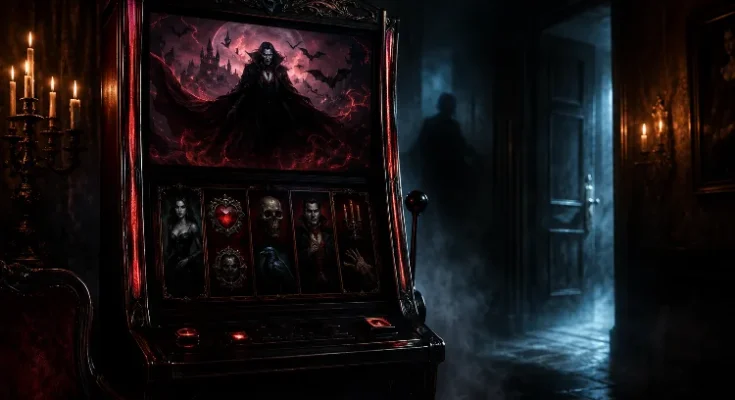
Horror-Themed Slots: Why Animation Makes Fear Feel Interactive
A creepy background can establish a horror theme, but atmosphere becomes much stronger once the scene starts reacting. A portrait suddenly moves. A vampire transforms. The lights flicker as the reels stop. A shadow passes behind the game board just before a bonus begins.
That sense of movement is one reason Horror-Themed Slots can feel very different from ordinary themed games.
Animation allows the environment to respond to what happens on the reels, while sound gives those movements weight and timing. Horror research in virtual environments shows that carefully designed surroundings can generate meaningful emotional reactions, including fear and negative affect.
Slots are obviously not survival-horror games, but designers can borrow the same audiovisual vocabulary—darkness, uncertain movement, abrupt changes, environmental sound, and anticipation—to turn a static theme into an interactive atmosphere.
Animation Makes the Background Feel Alive
A static haunted house is artwork.
A haunted house where curtains move, candles flicker, doors slowly open, and distant figures appear is an environment.
That difference matters.
Even subtle background motion can stop the interface from feeling like reels placed over a poster.
Designers can create atmospheric movement without distracting from gameplay. Fog might drift slowly behind the grid. Clouds can move across a moon. A chandelier can sway slightly during ordinary spins.
Then the animation can become stronger when the game changes state.
The key is contrast.
Normal motion remains subtle.
Feature motion becomes obvious.
That creates a visual hierarchy where players naturally notice mechanical events.
Research into frightening virtual environments suggests that environmental characteristics contribute to emotional responses, which helps explain why movement, spatial cues, and atmosphere can work together so effectively.
Characters Can Visually Announce Features
A horror character can be more than a high-value symbol.
It can become an animated interface element.
Imagine a vampire standing beside the reels. During normal play, the character barely moves. When a special feature activates, the eyes glow, the character transforms, and bats cross the screen.
The animation tells the user:
this event is different.
Play’n GO’s Count Jokula centres its theme around a transforming vampire and connects that idea directly with its Shapeshifter and respin features.
Likewise, Wild Blood 2 uses multiple vampire characters with individual abilities connected to the game’s bonus structure.
This approach creates stronger mechanic-theme alignment.
Instead of displaying an anonymous text box saying “feature activated,” the game world itself announces the feature.
That tends to feel more natural and visually memorable.
Transformation Is Especially Effective in Horror
Horror is full of transformation.
Humans become vampires.
People turn into werewolves.
Normal rooms become supernatural spaces.
Friendly characters become monsters.
These ideas translate unusually well to slot features.
A regular symbol can transform into a wild.
A normal reel can become corrupted.
A character can shift form before triggering a respin.
Play’n GO’s spooky-game catalogue includes examples involving vampires, werewolves, zombies, spirits, and transforming characters, showing how often horror imagery and transformation mechanics naturally overlap.
This works because the mechanic already resembles the story.
When an ordinary symbol turns into a wild, horror animation can present it as a supernatural change rather than simply replacing one image file with another.
The mathematics has not changed.
The presentation makes the mathematical state change feel meaningful.
That is a small but powerfull difference.
Lighting Can Control Attention
Lighting is one of the easiest ways to make a feature feel important.
The screen does not need to become completely dark.
Instead, designers can temporarily reduce background brightness while leaving important symbols illuminated.
A bonus character may appear in a bright doorway.
A wild could glow against a darker reel.
A multiplier can become the brightest object in the scene.
This technique directs attention without adding more interface elements.
Horror environments often use uncertainty and limited visibility to create tension. Research using virtual threat environments similarly employs environmental design and ambiguous cues to create expectations of danger.
Slots can use a much softer version of the same idea.
Darkening the edges of the screen while highlighting a potential feature keeps focus where it belongs.
The danger is readability.
If the design becomes too dark, users may struggle to distinguish symbols or important information.
Atmosphere should never make basic interaction harder.
Jump-Scare Logic Can Become Feature Pacing
A slot does not need literal jump scares to borrow their pacing structure.
The general formula is useful:
normal state,
anticipation,
sudden event,
release.
Research analysing jump scares describes similar temporal stages, including baseline audiovisual levels, anticipation, the arrival of a stinger, and a return toward baseline.
Imagine two scatters landing.
The background begins moving more slowly.
Music fades.
The remaining reel spins.
Then the third scatter appears with a sudden animation and sharp audio hit.
That is essentially horror pacing applied to feature presentation.
The game builds uncertainty and then resolves it.
Importantly, the technique can work even when the result is not frightening.
The genre simply gives designers permission to use more dramatic contrast.
Overusing the method, however, reduces its effect.
If every small win receives a screen-shaking animation, major features no longer feel major.
Reel Animation Can Become Part of the Story
Traditional reel animation has a straightforward job: symbols move and then stop.
Horror games can turn that basic movement into thematic behaviour.
Reels might appear scratched or distorted during a supernatural feature.
A ghost may pass through them.
A monster could physically destroy symbols before replacements appear.
Blood, fog, smoke, or shadows can visually connect cascades with the horror world.
Play’n GO describes Lordi Reel Monsters as using animated monster characters alongside grid interactions, with individual band members affecting symbols and wilds in different ways.
This is stronger than playing an unrelated character animation beside the reels.
The character’s movement has a direct relationship with the mechanical change on the grid.
As a result, the game feels more interactive even though the underlying outcome remains determined by its normal mathematical system.
Sound Gives Animation Physical Weight
Watch a monster slam into the reels with the sound muted.
Then add a deep impact, metallic vibration, and short musical accent.
The animation suddenly feels heavier.
Audio creates a sense of physical consequence that visual motion alone often cannot achieve.
Environmental audio can also suggest unseen threats, with research noting that sounds such as footsteps can imply activity outside the visible scene.
That technique is particularly useful for horror slots because much of the world sits outside the reel grid.
A sound from somewhere off-screen can make the interface feel larger than what is visible.
Developers can also give recurring features unique audio signatures.
A particular growl means one wild type.
A bell signals the scatter.
A rising tone accompanies multiplier growth.
After enough repetition, players can recognise mechanical events by sound even before the animation finishes.
That improves readability while strengthening atmosphere.
Bonus Rounds Can Shift Into a Different Horror World
A feature transition is an opportunity to change more than the reels.
The entire setting can evolve.
A normal game outside a mansion can move inside during Free Spins.
A quiet graveyard can become filled with ghosts.
A human character can transform into a monster.
The colour palette may shift, animation speed can change, and music can move into a more intense arrangement.
Wild Blood 2, for example, builds its features around a haunted mansion and vampire characters, with different bonus mechanics and character powers creating distinct feature states.
These transitions help separate base play from bonuses.
The user does not need to constantly check a counter to know something has changed.
The whole audiovisual enviroment communicates it.
This is where horror themes can be particularly effective because dramatic transformation already fits the genre.
Horror Atmosphere Needs Restraint
More animation does not always mean more atmosphere.
Constantly moving backgrounds can become distracting.
Repeated jump effects become predictable.
Excessive flashes can make features harder to follow.
The strongest horror usually leaves room for expectation.
Research into recreational horror found that enjoyment and fear can have a nonlinear relationship rather than simply increasing together indefinitely. While a slot is a different medium, the broader insight is useful: maximum intensity at every moment is not necessarily the most engaging presentation.
Designers need quiet phases.
A slowly moving shadow may be enough during ordinary spins.
Save the dramatic transformation for a meaningful mechanical event.
This produces better pacing and gives important animations more impact.
It also prevents the interface from becoming visually exhausting.
Horror-Themed Slots become more convincing when animation makes the game world react to features instead of simply decorating the reels. Character transformations, changing lighting, environmental movement, and audiovisual timing can communicate bonuses while building atmosphere.
The strongest designs use restraint, saving dramatic motion for meaningful events. When animation and mechanics move together, horror becomes part of the interaction rather than just the theme.