
How Free Demo Slots Work and What You Can Learn from Them

How Free Demo Slots Work and What You Can Learn from Them

Free slot demos are often described as practice games, but what can you actually practise? You cannot develop a strategy that controls random reels, yet you can learn a surprising amount about how a particular title is designed.

Once you understand how Free Demo Slots Work, demo mode becomes more than a collection of virtual spins.

It can help you compare game layouts, read symbol values, find bonus rules, and notice whether a slot moves quickly or slowly. The key is knowing which observations are useful and which conclusions would be misleading.

Use Demo Mode to Learn the Controls

Every slot arranges its buttons differently. The spin control may be obvious, while the paytable, sound menu, stake selector, or full-screen option can be less noticeable.

Demo mode gives you time to explore these settings without worrying about making an accidental real-money spin. You can also check whether the text and controls remain readable on a phone or tablet.

A poorly optimized game may feel cramped on a small screen even when its desktop version looks attractive.

Read the Paytable Before Spinning

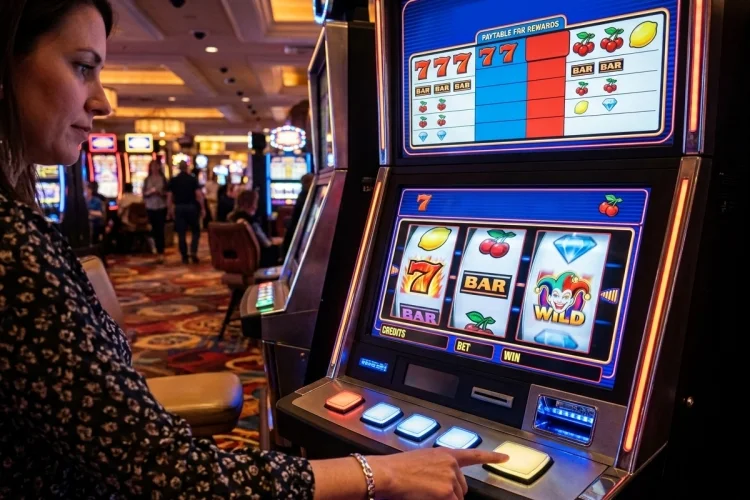
The paytable is the instruction manual for a slot. It explains symbol values, eligible combinations, special icons, and feature triggers.

Suppose a game includes a wild, a scatter, and a bonus symbol. The wild might replace ordinary symbols, the scatter could pay anywhere on the reels, and the bonus symbol may activate a separate feature.

These details vary, so never assume that two slots use identical rules simply because their layouts look similar.

Observe How Winning Combinations Form

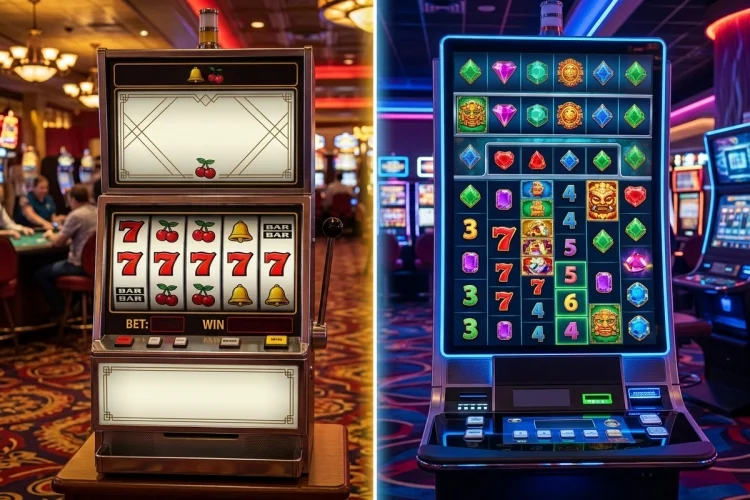
Some games use traditional paylines running from left to right. Others pay for clusters, matching adjacent symbols, or combinations that appear anywhere on the screen.

Demo play makes these differences easy to see. After a winning spin, the game usually highlights the relevant symbols and displays the virtual prize.

Watching several rounds can be more helpful than reading promotional language because you can see exactly how the interface identifies a win.

Explore Bonus Features and Special Symbols

Bonus rounds are often the most complicated part of a slot. They may introduce sticky wilds, increasing multipliers, expanding grids, respins, or collected symbols.

Official demos can show how these features operate. For example, Pragmatic Play explains that Gates of Olympus uses tumbling wins, multiplier symbols, and a 15-free-spin feature activated by at least four scatters.

Reaching the feature in demo mode helps you understand its presentation, but it does not show how often you will activate it in another session.

Notice Volatility, but Avoid Quick Conclusions

Volatility describes how prize size and frequency are distributed. A lower-volatility game generally aims for more frequent, smaller prizes, while a higher-volatility title may produce longer quiet periods and occasional larger outcomes.

However, 30 or 50 demo spins are not enough to measure volatility accurately. Random results can create an unusually active or unusually quiet short session.

The same caution applies to RTP. The percentage is a theoretical long-term average, not a session-level promise. Fully random games may require extremely large numbers of rounds before their observed returns move closer to the target figure.

Understand the Limits of Free Play

Demo mode cannot prove that a slot will be profitable. It cannot reveal the next outcome, create a winning system, or guarantee that a future version will use the same configuration.

In regulated British gambling facilities, free-play games must accurately represent the corresponding real-money game’s rules, likelihood of winning, and prize distribution.

However, supplier demonstrations on separate promotional websites may include disclosures when they use modified returns to showcase features.

Always read the information provided on the page.

Keep the Experience Recreational

Although virtual credits are not real money, demo games can still use fast animations, sounds, and repeated reward messages. Setting a simple time limit can prevent an intended five-minute test from becoming a much longer session.

Independent testing and regulatory oversight can address technical fairness, but they do not remove the need for personal limits. Game suppliers such as Pragmatic Play state that their products undergo external RNG testing and compliance reviews.

Knowing how Free Demo Slots Work helps you use practice mode for the right reasons. It is valuable for learning controls, reading paytables, comparing mechanics, and seeing how bonus rounds are presented.

It is not a forecasting tool, and a large virtual win says nothing reliable about the next session. Choose a trusted demo, open the information menu, and examine the game before pressing spin repeatedly.

Focus on whether the rules are understandable and the experience is enjoyable. When the session stops feeling casual, close the game and return another time.

Megaways Slots vs Traditional Payline Slots: Wins and Risk

Megaways Slots vs Traditional Payline Slots: Wins and Risk

The phrase “117,649 ways to win” sounds more attractive than “20 paylines.” However, comparing those numbers directly can be misleading. They explain how the game checks symbol combinations, not how frequently players make a profit.

This guide to Megaways Slots vs Traditional Payline Slots focuses on payouts, volatility, RTP, and practical risk. Megaways games often contain changing reels, cascades, and large maximum-win figures.

Traditional titles usually provide a fixed grid and easier-to-follow line patterns. Neither structure automatically offers a higher return.

Two games using different formats can share the same RTP while distributing their prizes in completely different ways. Understanding that distinction is more useful than choosing the title with the biggest advertised number.

More Ways Do Not Guarantee More Wins

A Megaways grid with 117,649 routes provides many possible combinations of symbol positions. Those routes only pay when the correct matching icons appear across the required reels.

A traditional slot with 20 paylines checks fewer predefined patterns. However, its symbol frequencies and payout table can be designed to produce wins at a different rate.

The number of ways or lines cannot reveal the full probability of winning. It must be considered alongside the mathematical model.

RTP Is Separate From the Slot Format

Return to Player represents the theoretical percentage of total wagers returned as prizes over extended play.

Megaways itself does not have one standard RTP. Individual titles and software versions can use different percentages. Traditional line games also vary widely.

The UK Gambling Commission requires regulated remote games to provide information such as RTP, house edge, or the probability of winning events before a customer gambles.

Check the percentage inside the active title rather than assuming that its reel format determines its value.

Volatility Shapes the Session

Volatility describes how prizes may be distributed. A high-volatility game may go through longer periods without a substantial payout but offer access to larger potential wins.

Many Megaways titles are promoted with complex bonuses and large maximum multipliers, which can be associated with high volatility. For example, Evolution describes MONOPOLY Megaways as a high-volatility game.

Traditional paylines can also be highly volatile. A fixed grid does not automatically mean steadier results.

Hit Frequency Is Not Profit Frequency

Hit frequency estimates how often a recognised winning combination occurs. It does not show how often a payout exceeds the stake.

Suppose a player wagers $1 and receives $0.40. The game records a win, but the net result is a loss of $0.60.

A title can therefore create frequent animations while gradually reducing the balance. Compare every return with the cost of the triggering spin.

Cascades Can Extend One Paid Round

Megaways slots frequently include reactions. After a winning combination, its symbols disappear and replacements enter the grid.

Several consecutive wins can therefore come from one initial stake. Bonanza uses Dual Reactions alongside up to 117,649 winning ways.

Traditional titles may also include avalanches or cascades. Gonzo’s Quest, for example, uses a 20-payline layout with avalanche mechanics and increasing multipliers.

Cascades are therefore common in Megaways but not exclusive to it.

Bonus Features Can Concentrate Returns

A portion of a game’s theoretical RTP may come from free spins, wild features, multipliers, or jackpots.

If important prizes are concentrated in a rare bonus round, the base game may feel less rewarding during short sessions. A title with simpler paylines may distribute its return differently.

This does not make either format better. It means players should check how the bonus is triggered, whether it can be retriggered, and how its payouts are calculated.

Compare the Cost of Repeated Spins

Stake size can affect a short session more immediately than a small RTP difference.

A $20 budget covers 100 spins at $0.20 but only 20 spins at $1, before accounting for returned prizes. A dynamic grid does not reduce the price of repeated rounds.

Confirm the total bet before every session. Do not increase it because the reels have recently displayed smaller grids or several near misses.

How to Make a Fair Comparison

Compare games using the same categories: official RTP, volatility, minimum stake, maximum payout, bonus contribution, and understandable rules.

Then consider the presentation. Traditional paylines may suit players who value consistency, while Megaways may appeal to those who enjoy changing layouts.

The best-informed choice is the game whose cost and mechanics you fully understand-not necessarily the one with the largest headline figure.

Megaways and traditional payline slots organise wins differently, but neither format removes random variation or the operator’s long-term mathematical advantage.

Megaways uses variable reels and adjacent-symbol routes, while traditional games evaluate fixed line patterns. Both can include cascades, free spins, multipliers, and high volatility.

Do not use the number of ways or paylines as a shortcut for judging value. Check the official RTP, understand how bonus features contribute to payouts, and calculate the cost of repeated spins.

Use only an affordable entertainment budget, avoid chasing losses, and choose a game based on clear rules rather than promises of easier wins.

What Is a Slot Machine? Bets, Odds, and Payouts Explained

What Is a Slot Machine? Bets, Odds, and Payouts Explained

Slot machines are simple to operate, but their numbers can be surprisingly confusing. A screen might show a coin value, betting level, total stake, account balance, number of paylines, jackpot value, and payout multiplier at the same time.

Anyone asking what is a slot machine should therefore understand more than reels and symbols. It is also a mathematical game in which every possible result has a programmed probability and prize value.

Learning how stakes, paylines, RTP, and volatility work cannot guarantee a profitable session. It can, however, help beginners understand how much they are risking and whether a displayed “win” actually produced a profit.

Start With the Total Stake

The total stake is the complete amount deducted when one paid round begins. It may be calculated from the coin value, number of coins, betting level, or active paylines.

Suppose a game charges $0.02 on each of 20 active lines. The total cost would be:

$0.02 × 20 = $0.40 per spin

Always check the final total rather than focusing on the smallest number displayed. Regulatory standards may require remote systems to show clear information about a transaction before the customer commits to it.

Use the Paytable as the Rulebook

The paytable lists the symbols, eligible combinations, prize values, bonus conditions, and maximum possible payout.

It may also explain whether winning symbols must begin on the leftmost reel, appear on adjacent reels, or form a cluster. Some games pay in both directions, while others use fixed lines.

Rules and information about prizes should be accessible before a player commits money. Because slot designs vary widely, assumptions based on another game can easily be incorrect.

Understand How a Payout Is Calculated

A payout can be expressed as credits, currency, or a multiple of the applicable stake. The important question is which bet value the multiplier uses.

Imagine that four symbols pay 25 times a line stake of $0.10:

25 × $0.10 = $2.50

The same symbols could produce a different prize when the stake changes. Maximum advertised wins may also require a particular bet level, so the conditions need to be checked carefully.

A Payout Is Not Always a Profit

Games may use sound effects and animations whenever a round returns any amount. However, the returned prize may be smaller than the original wager.

For example, betting $1 and receiving $0.30 creates a $0.30 payout but still leaves a net loss of $0.70.

The clearest way to measure the session is to compare the starting and ending balances. Celebratory graphics should not replace a basic calculation of how much money remains.

What RTP Really Tells You

Return to Player is the theoretical proportion of total stakes that a game is designed to return as prizes across a significant number of rounds.

If a game has a 95% RTP, its theoretical house advantage is approximately 5%:

100% − 95% = 5%

This does not mean every $100 session returns $95. The Gambling Commission explains that RTP is an average reached over substantial play rather than every time a machine is used.

Volatility Affects the Payout Pattern

Volatility describes how widely results may fluctuate. A lower-volatility slot tends to distribute more of its returns through smaller prizes, while a higher-volatility design may reserve more value for less frequent, larger outcomes.

Two games can have similar RTP percentages but feel completely different during short sessions. Neither pattern guarantees that an individual player will win.

Volatility should therefore be viewed as a description of risk distribution, not a tool for predicting the next result.

Random Results Cannot Be Timed

Digital machines use RNG systems to generate outcomes. Regulators expect those results to be unpredictable and statistically random.

Pressing spin at a particular second, changing machines after several losses, or waiting for a “hot” period does not create a dependable advantage.

A near miss also does not indicate that a jackpot is approaching. Each new round carries its own programmed probabilities.

Jackpots Have Separate Conditions

A fixed jackpot has a predetermined prize, while a progressive jackpot can grow as qualifying play contributes to its pool.

Progressive systems should clearly explain how prizes are funded and awarded. They should also disclose when a player or stake level is not eligible for the jackpot.

Read these conditions before playing. A large number displayed above the reels does not automatically mean every wager can win it.

A slot machine turns a selected stake into a random game result and then uses its paytable to calculate any prize. Understanding the total bet, payout multiplier, RTP, volatility, and jackpot conditions makes the cost of playing easier to evaluate.

These numbers describe the game but do not offer a method for beating it. Results remain unpredictable, and the operator retains a long-term mathematical advantage.

Before placing a wager, calculate the cost of repeated spins, choose a firm spending limit, and stop when that limit is reached. Play only where legal and view every stake as entertainment money that may be lost.